Kokomo Commercial Roofing FAQ
Answers on Roof Systems, Costs, Permits, and Winter Leaks
This Kokomo commercial roofing FAQ answers what building owners ask most about TPO, EPDM, industrial, and metal roofs, costs, permits, and weather.
Kokomo Commercial Roofing FAQ by Topic
Use this Kokomo commercial roofing FAQ to jump to a topic. Every answer is written for commercial buildings, from auto plants to storefronts.
Kokomo Commercial Roofing answers commercial roofing questions for building owners and facility managers in Kokomo, Indiana, and in Marion, Logansport, Peru, Wabash, and Rochester.
Commercial Roofing in Kokomo
How should a Kokomo building owner compare commercial roofing companies nearby?
Compare them on what they put in writing after walking your roof. A useful proposal names the roof system, membrane thickness, insulation and cover board, how flashings and edges are detailed, how tear-off debris and building operations are handled, and who pulls any permits.
Ask for proof of insurance and for photos of the problem areas they found. Vague, one-line bids are hard to compare.
What drives the cost of a commercial roof replacement in Kokomo?
Replacement cost on a Kokomo building is driven by roof size, how many existing layers must be torn off, the amount of wet insulation found, the new system and membrane thickness, insulation thickness, and how many penetrations, curbs, and drains need flashing.
Access, crane or lift needs, and working around operations also matter. A free on-site estimate measures these items and sets the price for that roof.
TPO or EPDM: which fits a Kokomo commercial building better?
Both are proven single-ply membranes, and the fit depends on the building. TPO is white and heat-welded at the seams, which suits buildings that want a reflective surface and strong seams. EPDM is a rubber membrane that stays flexible in cold weather and has a long track record on flat roofs.
Roof layout, rooftop traffic, chemical exposure, and budget decide between them.
How long does a commercial roof last in Kokomo?
TPO and EPDM roofs often last 20 to 30 years, and metal roofs often last longer, but no roof has a set lifespan.
What decides it is the quality of seams and flashing, how well the roof drains, foot traffic around equipment, and how Kokomo's freeze-thaw cycles, snowmelt, hail, and summer heat are handled through regular inspections and prompt repairs.
Can a Kokomo auto plant get a new roof without shutting down production?
Usually, yes. Re-roofing on a plant is phased in sections so only a small area is open at any time, and each section is closed and watertight before crews leave for the day.
Work around air intakes, rooftop units, and process exhaust is scheduled with the facility team, and protection is set up over sensitive lines below where needed.
TPO Roofing Questions
What is TPO roofing on a Kokomo commercial building?
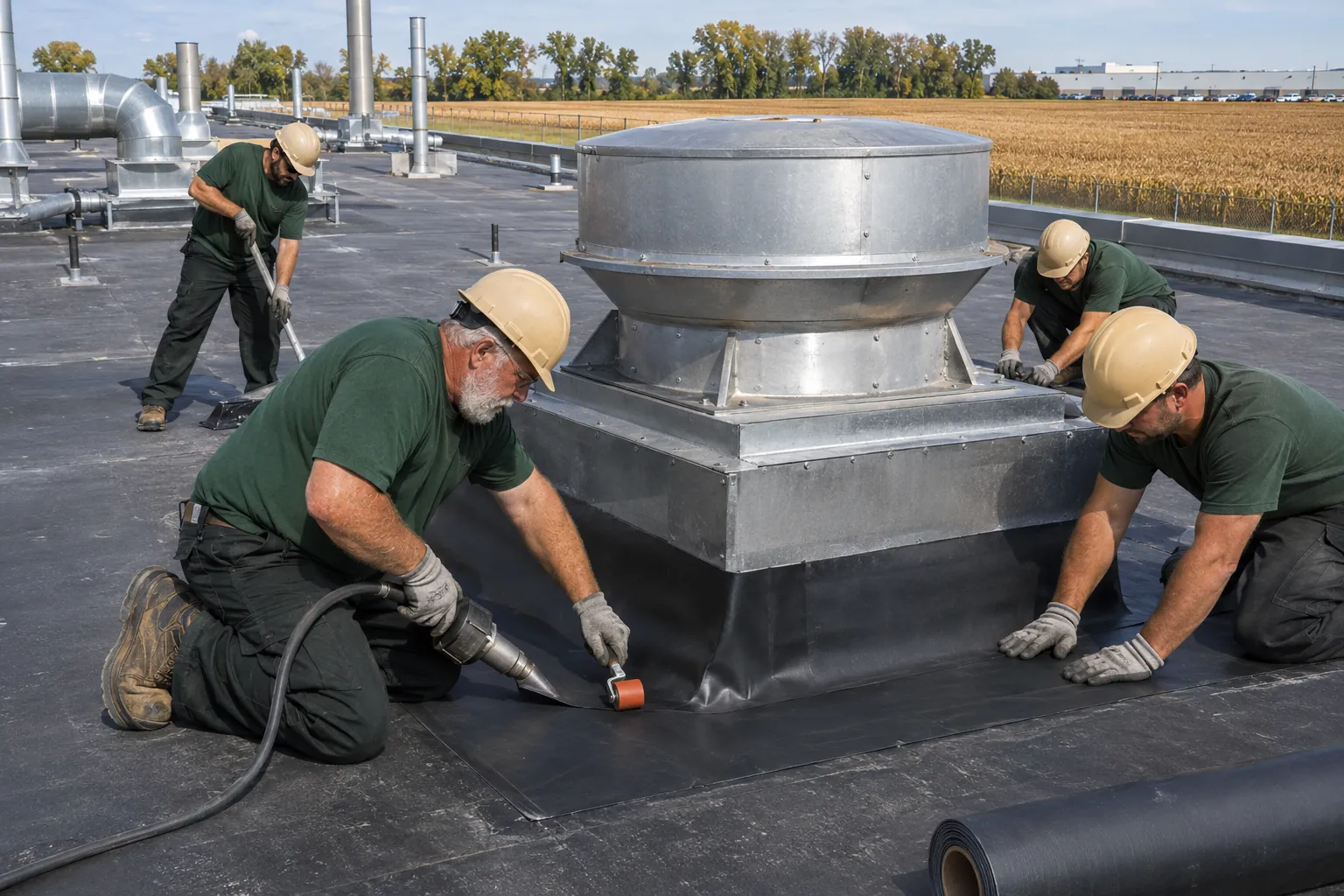
TPO, or thermoplastic polyolefin, is a single-ply membrane roll laid over insulation on flat and low-slope roofs. On Kokomo commercial buildings it is usually white, mechanically fastened or fully adhered, and its seams are joined with hot air into a single welded sheet.
It is widely used on warehouses, retail buildings, offices, and plants because it is light, reflective, and repairable.
What are the downsides of TPO roofing in Kokomo?
TPO's weak points are workmanship-sensitive. Poorly welded seams can open, and the membrane can be punctured by dropped tools or heavy foot traffic around equipment. Older TPO can become harder to weld for repairs. In Kokomo winters, fastened TPO roofs need sound attachment at edges and corners to resist wind.
Walkway pads, good welds, and careful flashing detail address most of these concerns.
How does TPO seam welding work on a Kokomo flat roof?
TPO seams are joined with a hot-air welder that melts the overlapping sheets together, so the seam becomes part of the membrane rather than a glued joint.
Crews test-weld samples each day to set the right temperature and speed for that day's weather, then probe every finished seam with a pick to find gaps. Cold or damp days on Kokomo roofs require adjusted settings.
Is TPO or EPDM easier to maintain on a Kokomo warehouse roof?
Each has its upkeep pattern. TPO seams are welded, so they rarely open when done right, and patches are welded on too. EPDM seams rely on tape and adhesives, which need checking as the roof ages, but the rubber itself stays flexible in cold weather.
On either one, clear drains, sound flashings at curbs, and walkway pads near equipment do the most to limit repairs.
Is TPO roofing used on Kokomo distribution warehouses?
Yes, often. Distribution warehouses have large, open, low-slope roofs where TPO's wide rolls and welded seams cover a lot of area with fewer joints. The white surface stays cooler in summer, and the membrane can be installed in phases over insulation while trucks keep moving below.
Skylights, roof hatches, and drains along the long runs get the most flashing attention.
EPDM Roofing Questions
What is EPDM roofing on a Kokomo flat roof?
EPDM is a synthetic rubber membrane, usually black, used on flat and low-slope commercial roofs. On Kokomo buildings it comes in wide sheets that are glued down, fastened, or held with ballast stone, with seams joined by seam tape and primer.
It stays flexible in cold weather and has decades of use on schools, offices, warehouses, and plants across the Midwest.
What common problems show up on EPDM roofs in Kokomo?
The most common EPDM problems are seams pulling apart as tape and adhesive age, flashing that shrinks away from walls and curbs, punctures from foot traffic or debris, and membrane shrinkage that tents at corners. Ponding at clogged drains speeds all of these up.
Kokomo's freeze-thaw cycles and snowmelt find any open seam, so annual seam and flashing checks catch problems early.
Fully adhered vs ballasted EPDM: what is the difference for a Kokomo building?
Fully adhered EPDM is glued to the insulation or cover board across its whole surface, so it lies flat and resists wind uplift without extra weight on the roof.
Ballasted EPDM is laid loose and held down with river stone, which is quicker to install but adds load and hides the membrane, making leaks harder to find. The roof structure and wind exposure guide the choice.
When does an EPDM roof on a Kokomo building need replacement instead of repair?
Replacement makes sense when seams are failing across the roof rather than in a few spots, the membrane has shrunk and pulled at most edges, or cores show wet insulation over large areas. A single puncture or failed flashing is a repair.
A full replacement tears off to the deck where needed, installs new insulation, and lays new membrane with new flashings.
How does EPDM handle Kokomo's winter cold and snowmelt?
EPDM stays flexible at low temperatures, so it handles the expansion and contraction of Kokomo winters without cracking. The weak points in winter are seams and flashings, where meltwater can sit if drains are blocked by ice.
Keeping drains and scuppers clear and sealing seam laps properly matters more than the membrane itself. Snow should be cleared carefully, since shovels can cut rubber.
Industrial Roofing Questions
What is industrial roofing for Kokomo plants and mills?
Industrial roofing is roof installation and replacement on buildings that house manufacturing, processing, or heavy equipment. On Kokomo plants and mills, these roofs are large, carry rooftop units, exhaust fans, stacks, and pipe supports, and may be exposed to heat, oils, or process residue.
The roof system and its flashings are chosen for those conditions, and the work is planned around operations below.
How is roofing handled around rooftop equipment on a Kokomo industrial building?
Rooftop equipment is where most roof leaks start, so each curb, pipe, and support gets its own flashing detail. Curbs are wrapped with membrane flashing to a set height, pipes get boots or sealed penetration pockets, and pipe supports sit on pads rather than bare membrane.
Walkway pads are laid along service routes so technicians do not wear through the roof.
What does an industrial roof replacement involve on a Kokomo facility?
An industrial roof replacement starts with core samples and a survey of every penetration. The work is then phased: a section is torn off to the deck, the deck is repaired where needed, insulation and a new membrane go on, and flashings are completed before the section is closed for the day.
Equipment may need to be raised on new curbs, coordinated with the mechanical contractor.
What should a Kokomo plant manager look for in industrial roofing contractors?
Look for a contractor who will survey the roof in person, take cores, and write a scope that addresses every penetration, the deck condition, and how work will be phased around production. Ask how they handle plant safety rules, hot work permits, fall protection, and crane lifts.
A clear schedule and a plan for daily watertight tie-ins matter as much as the membrane chosen.
What roof systems suit Kokomo steel and wire mills?
Mill roofs face heat, vibration, and residue from processes below, so the system is chosen for those conditions. Metal roofing and heavier-gauge single-ply membranes are common, with cover boards for added puncture resistance. Flashings around stacks and exhaust fans are built for higher temperatures, and drains are checked for buildup.
The right system comes from an inspection of the specific mill building.
Commercial Metal Roofing Questions
Standing seam or exposed fastener: which metal roof suits a Kokomo commercial building?
Standing seam roofs hide their fasteners under raised, interlocking seams and use clips that let panels expand and contract, so they have fewer leak points and handle temperature swings well.
Exposed-fastener panels are screwed through the face, cost less to install, and suit simpler buildings, but the screws and washers need periodic checking. Slope, budget, and building use decide between them.
Is commercial metal roofing a good fit for agricultural buildings around Kokomo?
Often, yes. Metal roofing is common on equipment buildings, storage buildings, and livestock or grain-related structures around Kokomo because it spans wide framing, sheds snow, and stands up to weather. Ventilation and condensation control matter on these buildings, so the roof may need a vapor retarder or insulation below the panels.
Trim and closures keep birds and pests out of the ribs.
Can a new metal roof go over an existing roof on a Kokomo building?
Sometimes. A metal roof can often be installed over an existing roof with a framing or sub-purlin system, which avoids a full tear-off and keeps the building closed during work.
It requires a sound structure that can carry the added weight, a dry existing roof, and compliance with the building code's limits on layers. An inspection and structural check confirm whether a re-cover is allowed.
What affects commercial metal roofing cost per square foot in Kokomo?
Per-square-foot cost for commercial metal roofing changes with panel type (standing seam or exposed fastener), steel gauge and finish, roof size and slope, whether the old roof is torn off or re-covered, insulation, trim and flashing details, and the number of penetrations. Access and crane needs also count.
A free on-site estimate measures the roof and prices it for that building.
Codes, Permits, and Kokomo Weather
Does a Kokomo commercial re-roof need a city building permit?
The City of Kokomo's commercial permit guide lists roofing among projects that do not need a city building permit, and it notes that some commercial projects need additional releases from the Indiana Department of Homeland Security. Structural repairs, new or relocated rooftop equipment, or deck work can change that.
We confirm the requirements with the city's permits department before each replacement starts.
Which building code applies to a commercial roof replacement in Kokomo?
Indiana commercial buildings fall under the Indiana Building Code, 675 IAC 13, adopted by the Indiana Fire Prevention and Building Safety Commission. The state's rules page lists the 2014 Indiana Building Code, based on the 2012 International Building Code, as currently in effect.
The local building department enforces it and can confirm what applies to a specific Kokomo roof replacement.
Why do Kokomo flat roofs leak when snow melts?
Snowmelt leaks start when ice blocks drains and scuppers, so meltwater backs up and sits against seams, flashings, and curb edges for days. Water finds any open lap or failed flashing that would shed a normal rain.
Clear drains before winter, heat-traced drains where ice keeps forming, and sound flashings at the low points reduce these leaks on TPO, EPDM, and older roofs.
How does spring hail affect TPO, EPDM, and metal roofs in Kokomo?
Hail affects each system differently. Metal panels may dent, though many dents are cosmetic. TPO can crack or puncture, especially over soft insulation, and EPDM can bruise or split at weak spots. A cover board under single-ply membranes adds hail resistance.
After a spring storm, a roof check with dated photos shows what needs repair and supports any insurance claim.
Does a white TPO roof make a difference in Kokomo summer heat?
A white TPO surface reflects more sunlight than a black membrane, so the roof surface stays cooler on hot summer days, which can reduce heat moving into the building. How much it matters depends on insulation, ventilation, and the operations inside.
Black EPDM absorbs more heat, which can help with snow melt in winter. Building use decides which trade-off fits.
Towns Around Kokomo
Do you replace TPO roofs on industrial buildings in Marion, Indiana?
Yes. We install and replace TPO roofs on industrial and commercial buildings in Marion. A replacement starts with cores to find wet insulation, then the old roof is removed in phases, the deck is checked, and new insulation and welded TPO go on with new flashings at every curb and drain.
Marion's local building department confirms any permit needs before work begins.
Can an aging EPDM roof on a Logansport commercial building be replaced in phases?
Yes. On a Logansport commercial building, an EPDM replacement can be split into sections so only part of the roof is open on any day. Each section is torn off, dried in with new insulation and membrane, and tied into the old roof watertight before the crew leaves.
Phasing keeps tenants, stock, and equipment protected while the full roof is completed.
Is standing seam metal roofing an option for commercial buildings in Peru, Indiana?
Yes, where the roof slope allows. Standing seam metal suits Peru commercial and light industrial buildings that want concealed fasteners and panels that move with temperature changes. Low-slope buildings need a panel and seam rated for that pitch, and flat roofs may need a framing system to add slope.
An inspection of the structure and slope tells which panel profile fits.
What replaces an old built-up or tar roof on a commercial building in Wabash?
Older built-up roofs on Wabash commercial buildings are commonly replaced with single-ply TPO or EPDM over new insulation, after the old layers are removed down to the deck. Older buildings may have parapet walls, internal gutters, and patched decks that need repair first.
The new system is chosen after cores show what is under the surface and how the roof drains.
Do you handle industrial roofing for plants in Rochester, Indiana?
Yes. We handle industrial roofing on plants and manufacturing buildings in Rochester, including roofs with heavy rooftop equipment, exhaust fans, and process penetrations. Work starts with a roof survey and cores, then a phased plan so production keeps running.
Flashings around equipment, walkway pads on service routes, and drainage at low points are part of every scope.
Sources for the local permit and code answers:
Still Weighing Your Options?
Leaking Now?
Dealing with a leak while you read? Call us, tell us where it shows, and we will plan the first visit around it.
Call UsPlanning A New Roof?
Comparing systems for a replacement? Book a free inspection and get a written scope for your own roof.
Get A Free EstimateMore Kokomo Commercial Roofing FAQ Answers by Phone
Have a question about your own roof? Call us or request a free estimate, and we will answer it on the roof.